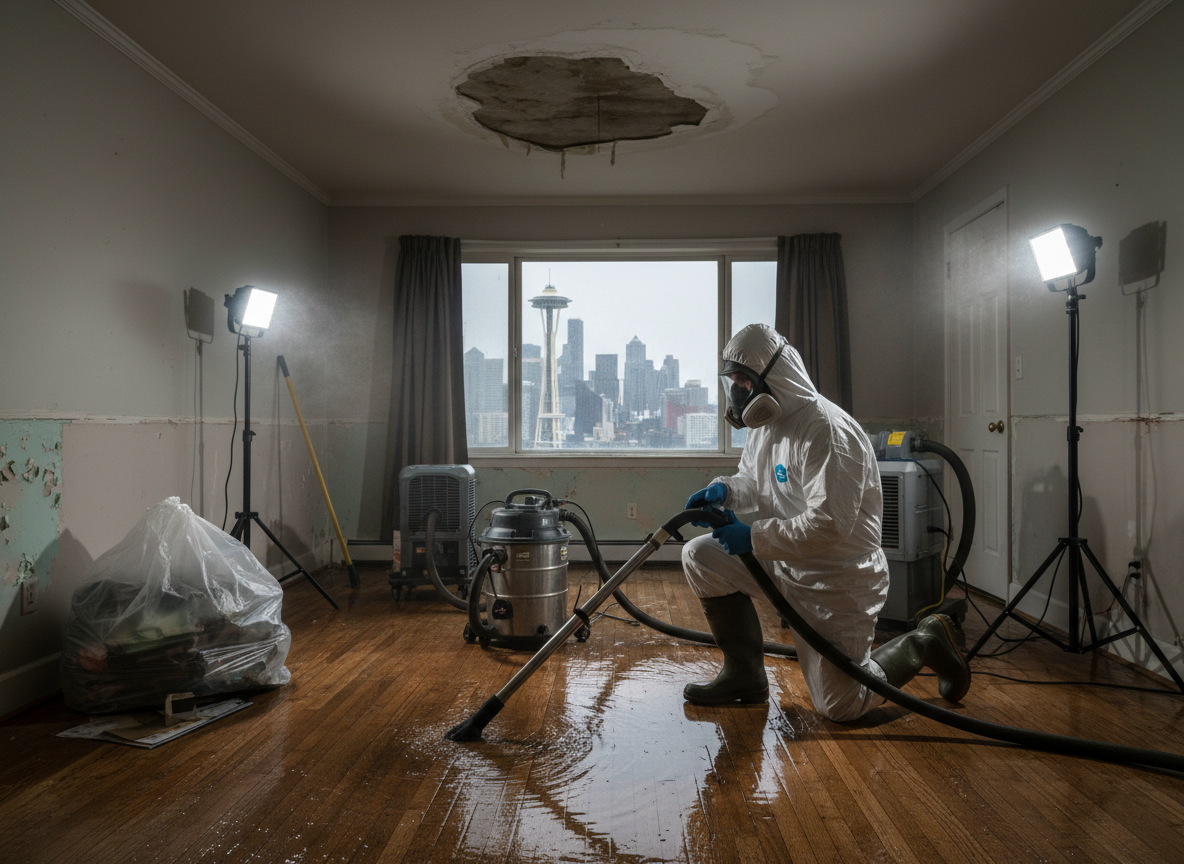
Seattle's older housing stock in neighborhoods like Capitol Hill and Queen Anne often features balloon framing and plaster walls that trap moisture after a roof leak or pipe burst. Wet winters with frequent overcast skies keep relative humidity high, so standing water in basements or crawl spaces can wick into subfloors within hours. Technicians must pull baseboards early and use moisture meters on lath-and-plaster to locate hidden saturation before mold sets in.
In Ballard and Fremont, many homes sit on sloped lots near the ship canal where groundwater pressure rises during prolonged rain. Extraction equipment must handle both surface water and seepage through old brick foundations common in these blocks. Technicians also check for compromised knob-and-tube wiring that can short when insulation gets wet, a detail that changes the sequence of drying.
University District and Belltown apartments frequently experience unit-to-unit leaks through shared concrete decks. Cleanup crews coordinate with property managers to isolate HVAC returns so spores do not travel between floors. Drying plans account for the limited natural ventilation caused by the region's dry summers turning quickly back to overcast fall rains.
West Seattle homes near Discovery Park often have cedar siding that absorbs water during wind-driven storms off Puget Sound. Restoration includes removing saturated insulation behind siding while protecting the views and access routes that matter to residents. All work respects King County permitting rules for structural drying when walls must stay open longer than 72 hours.
Technician insight
In Seattle the thing that catches most people out with Water Damage Cleanup is how quickly moisture travels behind plaster in pre-war homes on Capitol Hill and Queen Anne once winter rains start. Homeowners often stop at visible puddles and miss the fact that the balloon framing channels water down to the first-floor subfloor. We always pull baseboards on day one because the region's frequent overcast keeps humidity high enough to restart mold growth within 48 hours.
Queen Anne Row House Leak
A second-floor supply line leaked overnight into a 1920s row house. Water traveled behind plaster into the dining room ceiling and down into the finished basement. Crews extracted water, opened walls at two levels, and ran drying equipment for five days until meters read dry. The homeowner avoided mold and kept the original hardwood intact.
Water Damage Cleanup Services We Offer
✓Emergency Water Extraction
Rapid removal of standing water from basements and first floors using truck-mounted pumps before humidity damages hardwood in Capitol Hill and Queen Anne homes.
✓Structural Drying and Dehumidification
Placement of commercial air movers and dehumidifiers to pull moisture from plaster walls and subfloors common in pre-1950 King County housing.
✓Basement Water Cleanup
Targeted extraction and drying for below-grade spaces in Ballard and Fremont where canal proximity raises groundwater after heavy winter rain.
✓Ceiling and Wall Cavity Drying
Inspection and drying of interstitial spaces behind lath and plaster in University District apartments to prevent hidden mold growth.
✓Sewage and Contaminated Water Cleanup
Full containment, removal, and disinfection of Category 3 water in West Seattle homes near older sewer lines.
✓Content Cleaning After Water Damage
On-site and off-site cleaning of furniture, documents, and textiles affected by leaks in Belltown condos and nearby Bellevue rentals.
Water Damage Cleanup Cost in Seattle, WA
| Service | Typical Range | What Affects It |
|---|---|---|
| Category 1 Water Extraction | $450–$900 | Clean water from supply lines; price rises with finished basement square footage. |
| Category 2 Or 3 Water Extraction | $800–$1,800 | Gray or black water requiring extra PPE and disposal in older King County homes. |
| Drying Equipment Rental Per Day | $150–$350 | Number of air movers and dehumidifiers needed for plaster walls in Capitol Hill or Ballard. |
| Content Pack-Out And Cleaning | $600–$1,400 | Varies by volume of items and whether off-site storage in Seattle is required. |
Ranges are typical for Seattle, WA and confirmed with an exact written quote before any work starts.
How it works
- 1
On-Site Assessment
Technicians arrive from the Cloverdale Street shop, map moisture with meters, and document affected rooms in the specific Seattle neighborhood.
- 2
Water Removal
Pumps and extractors pull standing water while protecting electrical systems typical of older King County homes.
- 3
Drying Setup
Air movers and dehumidifiers are positioned based on wall construction and local humidity patterns.
- 4
Monitoring And Final Clearance
Daily readings continue until materials reach dry standards, then equipment is removed and the space is returned to the owner.
Pricing
Pricing depends on water category, square footage, and how many days drying equipment must run in Seattle's variable humidity.