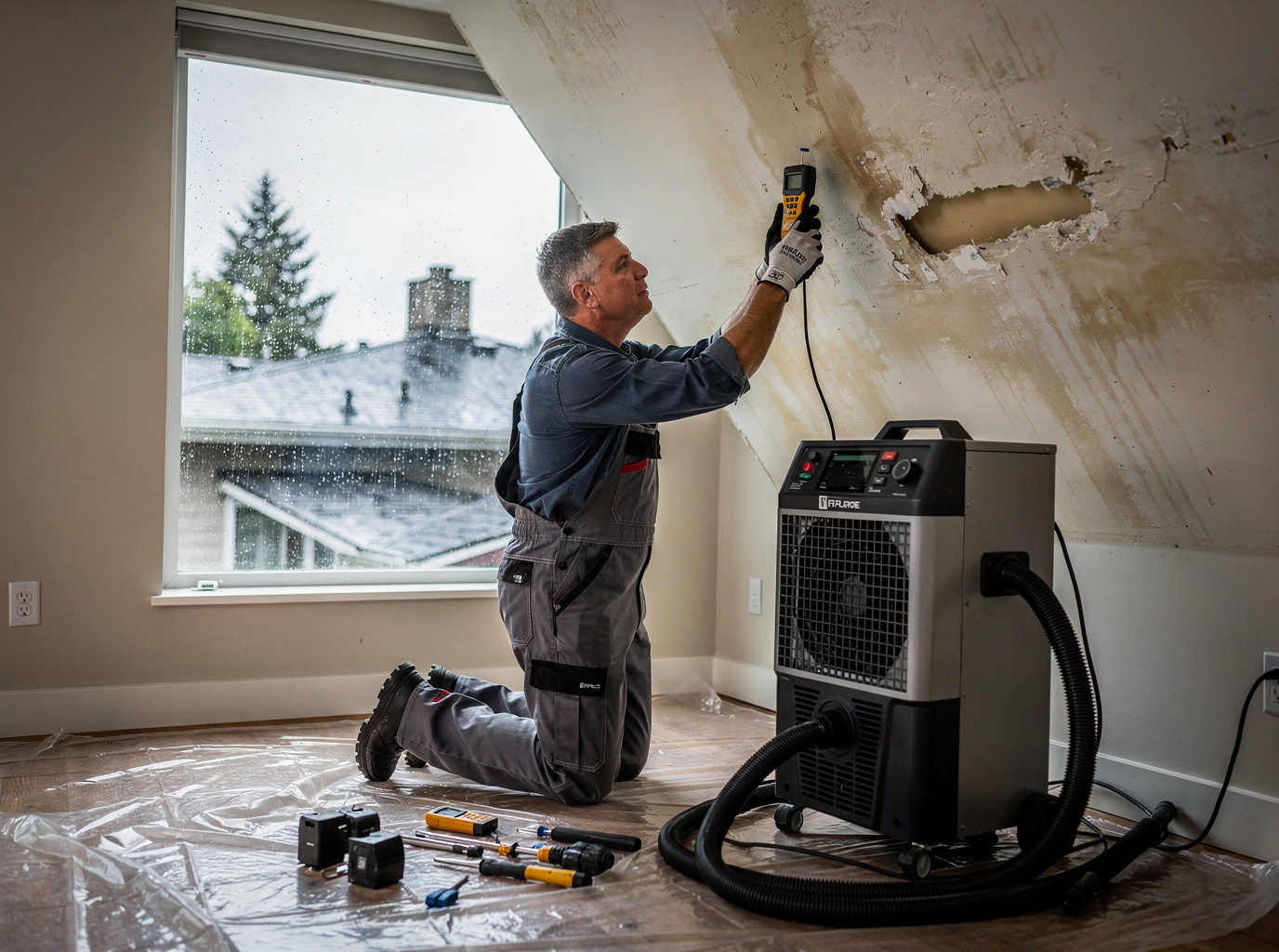
Seattle's frequent overcast skies and mild wet winters push water into older homes built before modern vapor barriers, especially in Capitol Hill and Queen Anne where many properties date to the early 1900s. Water follows the slope of the land toward lower floors and crawl spaces, saturating hardwood subfloors and plaster walls that hold moisture far longer than newer drywall. Technicians must pull baseboards, cut weep holes, and use moisture meters on brick foundations common in these neighborhoods to locate hidden saturation before it reaches neighboring units in attached housing stock.
In Ballard and Fremont, post-war bungalows with flat or low-pitch roofs see repeated roof deck leaks during the dry-summer-to-wet-winter transition. Once water reaches insulation, it travels along ceiling joists into multiple rooms. Proper repair requires removing affected drywall sections, drying the cavity with directed air movers, and treating joists with antimicrobial solution rather than simply painting over stains. Skipping these steps leaves residual moisture that reappears as efflorescence on the next rain cycle.
West Seattle homes on sloped lots face groundwater intrusion through cracked foundation walls during heavy winter rains. Extraction equipment must be staged on the uphill side to prevent re-flooding, and dehumidifiers sized for the square footage keep relative humidity below 50 percent while the structure dries. Technicians document every step with photos because King County permitting often requires proof of complete drying before interior finishes can be replaced.
Technician insight
In Seattle the thing that catches most people out with Water Damage Repair is how quickly water travels along the slope of older lots in Capitol Hill and Queen Anne during our long wet winters. Homeowners often stop at visible puddles and miss saturation behind plaster walls or under hardwood that sits on brick foundations, so the job expands once we pull baseboards and start metering.
Queen Anne Row House Ceiling Leak
Water from a neighbor's overflowing gutter had traveled under the shared roof deck and soaked insulation above three rooms. Extraction removed standing water from the attic space while directed drying kept the plaster ceilings intact on the lower floors. After four days of monitoring, only two small drywall sections needed replacement and the home returned to normal humidity levels before any mold developed.
Water Damage Repair Services We Offer
✓Basement Water Extraction
Removes standing water from Seattle basements using submersible pumps and wands, then applies air movers to prevent mold growth in older concrete foundations common in Capitol Hill and Queen Anne.
✓Ceiling Leak Repair
Locates and stops roof or pipe leaks above plaster and lathe ceilings in pre-war homes, followed by drying the cavity and replacing damaged sections to restore structural integrity in Ballard and Fremont bungalows.
✓Flooring Water Damage Restoration
Extracts moisture from hardwood and subfloors, then uses targeted drying to limit cupping and warping in University District and Belltown apartments where water travels between units.
✓Emergency Water Removal
Provides rapid on-site water removal for burst pipes or appliance failures, protecting nearby homes in West Seattle and Discovery Park areas from secondary damage during winter storms.
✓Structural Drying Services
Deploys industrial dehumidifiers and moisture monitoring across wall cavities and crawl spaces to bring King County homes back to safe drying levels after prolonged exposure.
Water Damage Repair Cost in Seattle, WA
| Service | Typical Range | What Affects It |
|---|---|---|
| Initial Assessment and Moisture Mapping | $175–$350 | Varies by square footage and number of levels in older Seattle homes. |
| Water Extraction | $400–$900 | Higher when multiple rooms or crawl spaces are involved. |
| Equipment Drying (per day) | $250–$550 | Includes daily monitoring; length depends on material saturation. |
| Drywall and Insulation Removal | $300–$750 | Based on linear feet of affected walls in pre-war construction. |
Ranges are typical for Seattle, WA and confirmed with an exact written quote before any work starts.
How it works
- 1
On-Site Assessment
Technician arrives within hours, maps moisture with meters, and identifies affected materials in the specific Seattle neighborhood.
- 2
Water Extraction
Standing water is removed using pumps and extraction tools sized for the volume found in the property.
- 3
Drying and Monitoring
Air movers and dehumidifiers run while daily moisture readings track progress until levels reach safe thresholds.
- 4
Repair and Restoration
Damaged drywall, flooring, or insulation is replaced and finishes are restored to match the original construction.
Pricing
Pricing depends on the volume of water, number of affected rooms, and whether hidden cavities require demolition. Most jobs begin with a site visit to provide an upfront range.